
How Already Late Bridges Tokyo and Brooklyn, One Show at a Time
Already Late is a Japanese-English indie band bridging Japan and America's music scenes, one Brooklyn show at a time.


Learn how a NYC indie band authentically bridges Japanese and American music cultures, creating genuine connections that transcend language barriers. Already Late’s approach offers a blueprint for meaningful cross-cultural artistic collaboration.
“Sometimes Japanese is just easier for me to communicate how I feel,” reveals Johnnie Noct of the indie band Already Late. This insight from their recent conversation with Peatix captures how authentic cross-cultural expression is transforming the city’s musical landscape.
The three members, Johnnie Noct, Hakase, and B-stixx, have evolved from Pennsylvania college students to cross-cultural musical ambassadors building bridges between Japanese and American indie scenes through their unique bilingual songwriting approach.
Based across the New York metropolitan area with Hakase in Queens, Johnnie in the Bronx, and B-stixx in Jersey City, they’ve become genuine cultural ambassadors creating music that resonates across linguistic boundaries.
Their journey spans over a decade with various lineup changes, but B-stixx recalls the moment everything clicked: “I still remember that call from Johnnie vividly, asking if I could play drums for them at Pianos, the iconic New York venue. I jumped at the opportunity immediately. We’d always talked about being in a band together, and finally, it was happening.”
From Countless Variations to Authentic Alignment
“We’ve had countless variations of the band with different members and managers, but this current chapter feels the most right. We’re more aligned than we’ve ever been.”
— B-stixx
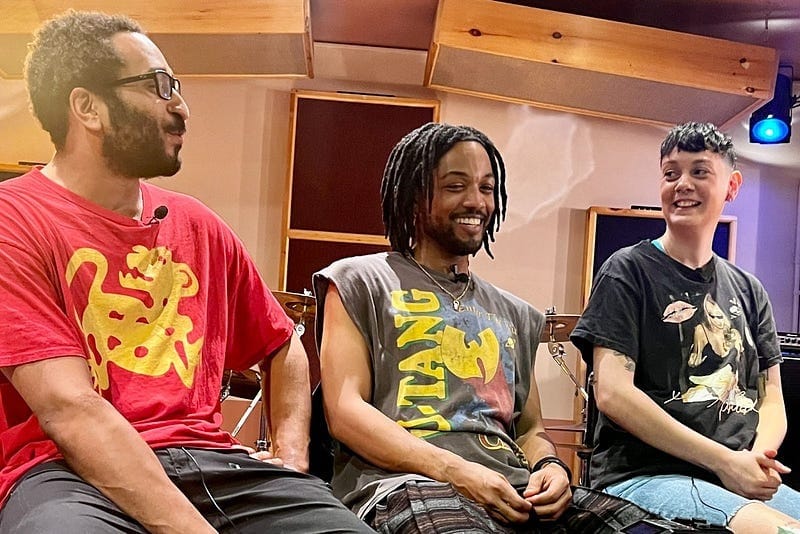
“We’ve had countless variations of the band with different members and managers, but this current chapter feels the most right,” B-stixx reflects. “We’re more aligned than we’ve ever been. The past 10+ years have taken us through so much, but that’s exactly what shaped us into the band we are today, a group that can finally be our true, authentic selves creatively.”
This decade-long journey of experimentation and growth created the foundation for their current success. The various lineup changes and creative explorations weren’t setbacks; they were essential steps toward finding their authentic voice.
Their embrace of Japanese cultural elements became a defining moment in this evolution. “I remember when we first started writing music in Japanese. I thought it was incredible to weave that culture into our sound,” B-stixx explains. “I could see how much it meant to Hakase and Johnnie, so I was all in. As someone who loves traveling and learning about cultures beyond my own, it felt like the perfect opportunity to dive deeper.”
This cultural curiosity and openness to learning reflect the genuine respect that distinguishes Already Late’s approach from surface-level cultural borrowing. B-stixx’s enthusiasm for exploring cultures beyond their own demonstrates how authentic cross-cultural music collaboration requires active participation and genuine interest from all members.
“We’re all just learning from each other,” Hakase explains, highlighting their collaborative creative process that extends beyond the band to encompass ongoing engagement with Japanese culture, language, and artistic traditions.
Riding the City Pop Wave
Already Late’s emergence coincides with Japanese music’s mainstream breakthrough in America. The smooth, sophisticated city pop style from the 1970s-80s is finding new global audiences through streaming platforms, with Japanese musical elements appearing everywhere from restaurant playlists to indie venues.
“City pop is a thing now,” Johnnie confirms. “I feel like it’s become way bigger than it was before. Not just city pop. There’s also future funk, which is like city pop but remixed, and other things around that.”
For Already Late’s generation, anime served as the cultural gateway. “When we were in middle school and growing up with it, it wasn’t as popular as it is now. It wasn’t socially accepted,” Hakase recalls. “So it was kind of secretive. It wasn’t accessible at all.”
Now, that dynamic has completely reversed. “Things have changed dramatically in the past few years, and now it’s this global phenomenon. Everyone’s into all aspects of Japanese culture, it seems, just because anime is probably the biggest entry point,” Johnnie explains.
This cultural shift has created unprecedented space for authentic cross-cultural artistic expression, inspiring artists who genuinely bridge cultural traditions rather than simply borrowing surface elements.
Musical Influences: From Math Rock to Creepy Nuts
The band’s Japanese influences span multiple genres, revealing sophisticated musical understanding. “I like Vaundy, who does the intro for Creepy Nuts,” Johnnie mentions, referencing the popular Japanese hip-hop duo that’s gaining recognition even in Queens. Vaundy is a rising Japanese indie rock artist whose melodic sensibilities have influenced a new generation of cross-cultural musicians.
Their influences extend beyond mainstream: “I got started with Asian Kung-Fu Generation, basically just the anime openings and stuff,” Johnnie explains. “And then I started getting into Japanese math rock and stuff because they go hard.” Math rock, characterized by complex rhythmic structures and intricate guitar work, represents the technical sophistication that draws Already Late to Japanese artists.
“In Japan, musicians stress more about actually being very good at their instruments. They’re really quick to bring classical and jazz influences.” — Hakase & Johnnie
What distinguishes Japanese music? “In Japan, musicians stress more about actually being very good at their instruments,” Hakase observes. Johnnie elaborates: “They’re really quick to bring classical and jazz influences. It feels like in Japan you learn music basics, classical, then jazz.” This foundational approach creates the harmonic complexity that sets Japanese indie music apart from more straightforward Western chord progressions.
Why Japanese for Deep Emotions
For Johnnie, writing in Japanese isn’t a novelty; it’s authenticity. “The first rap song I ever wrote was in Japanese as well, but sometimes Japanese just feels easier to communicate how I feel because I don’t have to say as much.”
This becomes crucial for personal material. “The deepest songs I feel like are all in Japanese,” he reveals. Their track “Blue Coco” emerged from lockdown isolation: “That whole album was written during the lockdown. It was the first time for me where I was just alone, and it was okay for me to just be at home recording stuff because nothing was happening. You know, it’s really personal, deep, sad things that I’m drawing from. So I was like, it’s in Japanese.”
🎵 Listen to “Blue Coco” to experience their bilingual approach firsthand.
From Kitsune to Hakase: Cultural Identity
Hakase’s stage name evolution reveals cross-cultural artistic challenges. “Before I was Hakase, I was Kitsune,” he admits somewhat sheepishly. “And I thought that was cool because that’s like my spirit animal. But everybody thought I was a furry. So I was like, ‘I can’t have this.’”
The transition to Hakase (Japanese for “professor”) reflects his academic background and producer role. “I was in college at the time, and I was doing Japanese as my major. So I was like, I’m pretty nerdy. Let me go with professor. And I thought it sounded cool, and I thought it was obscure enough that no one would call me a furry.”
Live Performance: Cultural Exchange in Action
Their Tokyo performance revealed striking audience differences. “I saw a big difference in audience participation compared to our local shows,” Hakase notes. “Very good feedback.”
“Even when language barriers arose, I knew the audience would understand the connection, love, and care we pour into our music. Music truly is universal.” — B-stixx
For B-stixx, the Tokyo show validated their cross-cultural approach and reinforced their belief in music’s universal power. “Even when language barriers arose, I knew the audience would understand the connection, love, and care we pour into our music. Music truly is universal.”
This perspective speaks to the heart of what makes Already Late’s approach authentic. They’re not just performing Japanese-influenced music; they’re creating genuine emotional connections that transcend linguistic boundaries.
Locally in New York, their bilingual approach requires audience education but gets a positive response. “Every time we give a warning. As long as it sounds good, it doesn’t matter,” Johnnie explains.
DIY Approach and Community Building
Already Late’s recording evolved from expensive studios to streamlined DIY. “We have gone into a professional studio and hired an engineer and spent days in there recording an album, our first album,” Johnnie explains. “And then now we have… It’s a lot more accessible and streamlined now for recording. So we have this place and book it for a few hours, and we record stuff here.”
“I feel like you have to nowadays. It’s so DIY. Everyone kind of has to wear a couple of hats,” Hakase observes. “It’s like a business.”
Their audience strategy reflects an understanding of cross-cultural art serving multiple communities. “I feel like there are a few crowds that we’re leaning towards, not only LGBTQ+, but also POC, and also Japanese,” Hakase explains. “Just wherever we can fit.”
What’s Next: Second Tour and Japan Recording Opportunity
Already Late regularly performs across NYC’s Japanese music community and beyond, building cross-cultural communities through their live shows. “We’re trying to hit the festival scene,” Hakase explains, reflecting aspirations extending to national stages.
The band is currently on the brink of announcing their second tour and has reached the semi-finals for an incredible opportunity to record music in Japan. “We’re working on new material that feels more authentic than anything we’ve created before,” B-stixx shares. “I’m genuinely proud of where we are and excited for what’s coming next.”
This sense of pride and forward momentum reflects how their decade-long journey of growth, cultural exploration, and authentic collaboration has positioned them for their most exciting chapter yet.
Supporting Cross-Cultural Artists: The Peatix Mission
Their goal to reach Japanese audiences reflects the kind of authentic cultural bridge-building that Peatix champions. “That’s what we’re trying to tap into,” Johnnie says about connecting with Japanese music fans worldwide.
Artists like Already Late represent precisely the type of cross-cultural creators that inspire Peatix’s mission, those who approach Japanese culture with genuine respect and understanding. If you’re organizing similar cross-cultural events, consider using Peatix to connect with audiences who appreciate authentic cultural exchange.
Events like this show how Peatix helps organizers create meaningful cultural connections, bringing together communities around shared appreciation for genuine artistic collaboration.
Experience Japan Wherever You Are
Already Late embodies the spirit of Peatix’s core mission of helping people “Experience Japan Wherever You Are.” Whether in a Queens recording studio listening to Johnnie navigate between languages, or watching American artists respectfully engage with Japanese traditions, their music creates authentic cultural bridges.
Artists like Already Late represent the future of cross-cultural collaboration, genuine, respectful, and deeply connected to the cultures they draw from.
Inspired by Already Late’s authentic approach? Peatix provides everything you need to organize cross-cultural music events that build genuine community connections. Start organizing today.
Follow Already Late on Instagram for updates on performances and releases.
FAQ: Cross-Cultural Music Collaboration
Q: How does Already Late use Japanese in their music? A: They use Japanese when it feels most natural for emotional expression. “Sometimes Japanese is just easier to communicate how I feel,” explains Johnnie Noct. Their most personal songs tend to be in Japanese.
Q: What Japanese artists influence them? A: They draw from Creepy Nuts, Asian Kung-Fu Generation, Vaundy, and city pop influences. They appreciate how Japanese musicians emphasize instrumental skill and incorporate classical/jazz elements.
Q: Where can I see them perform? A: Follow @werealreadylate on social media for their latest show announcements, including their upcoming second tour. To experience Japanese culture firsthand, explore Peatix’s unique events happening in Japan.